TELLING STORIES THROUGH ART
thomas james is
a visual arts curator and content creator based in Maryland. An appreciator and collector of fine arts, Thomas James highlights working artists and facilitates spaces for creatives to refine and develop their craft.
Learn More
His shows have been called "the greatest piece of art in the gallery." Experience Thomas James' curatorial works or read the full bio below.
CURATIONS
Thomas James' curatorial experiences tell stories through the artwork. Take a look at previous exhibits or attend an upcoming gallery opening.
Explore
PRESS + FEATURED
Thomas James has been featured in Bmore Art Magazine, Inertia Studio Video, and more.
See What People Are SayingBLOGS + VLOGS + RECORDINGS

I am officially a graduate of Central Saint Martins College of Art, University of the Arts London with an MA Culture, Criticism and Curation. Now, what does that actually mean? Formally, it means that I completed a rigorous course of study reading cultural theorists such as Stuart Hall, Raymond Williams, and Sadiya Hartman; critically examining culture and curatorial practice through decolonized, feminist, and queer frameworks; and investigating a multitude of curatorial strategies and interventions through historical research and in-person experiences around the city of London. Overall, the program's main purpose was to help students become better researchers and consider critical curatorial modalities within and beyond exhibition-making. Informally, I used this time as an opportunity for incubation and cultural exchange. While living abroad I explored every inch of London I was able to access and I also visited 20 other countries – sometimes for structured enrichment such as the Unschool of Curating in Romania, other times to visit friends, family, and colleagues, and experience some incredible arts and culture. Moreover, while in school I conducted some of the most exciting research I’ve ever done: writing my dissertation (or thesis as we call it in the states) on a community-rooted transcuratorial practice that serves as a unique space for knowledge production and soft infrastructure. In the near future, I'll be able to fully synthesize my experience in grad school, but in the meantime I’m happy to share my dissertation research with anyone who is interested! Here is a little piece of the abstract: This dissertation proposes a new framework and term for understanding an emergence within contemporary curatorial practice in which practitioners are applying curatorial thought and approaches to lead on-going, community-rooted projects, initiatives, and organizations, extending beyond exhibition-making and other traditional curatorial modalities, and functioning as a methodology for creatively contributing to arts and cultural infrastructure through unique forms of access, connectivity, knowledge production, and support for creatives. Please click the link below to download my dissertation research:
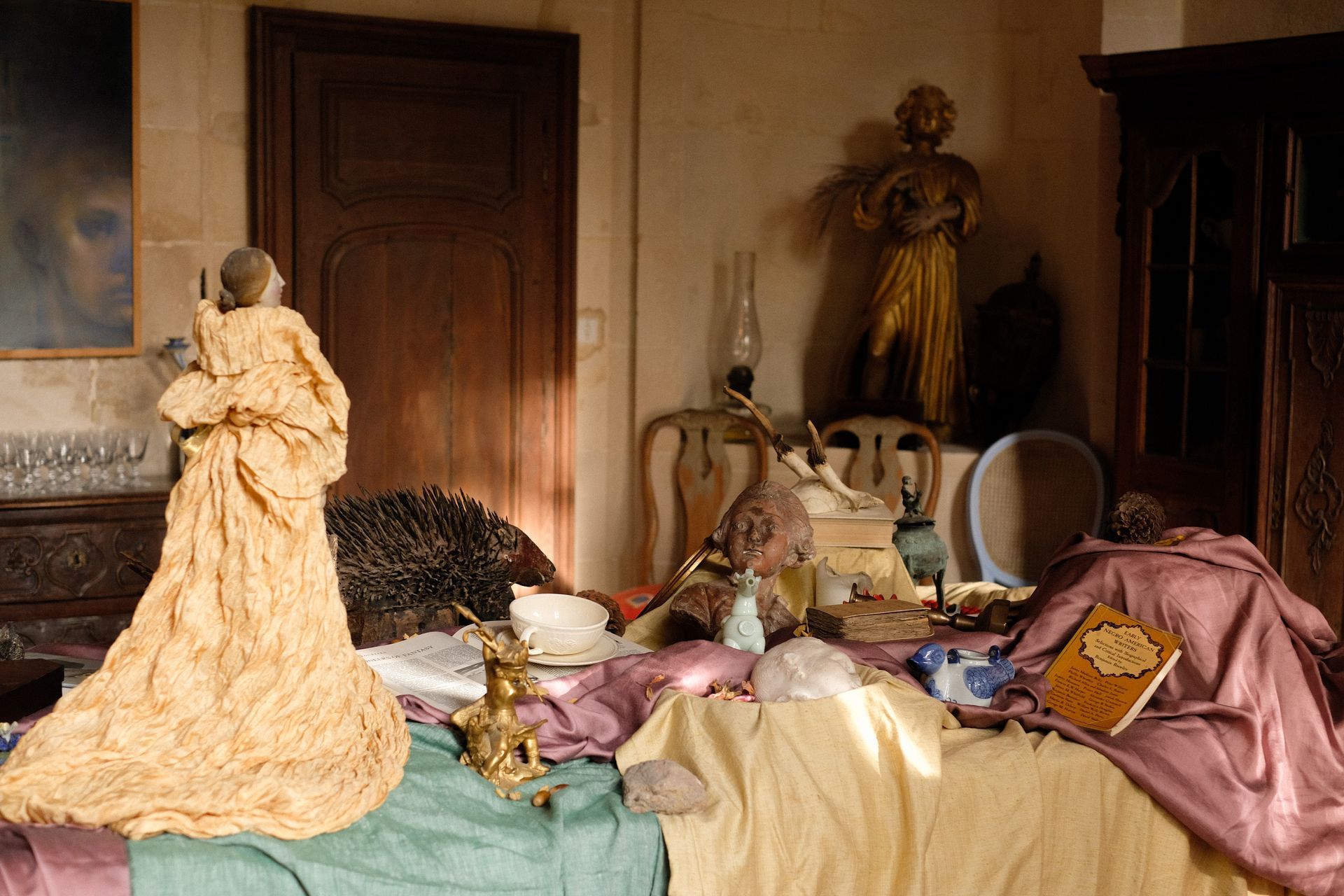
Présentation d’archives de la Maison Saint-Joseph was developed during my residency at Maison Saint-Joseph in Crépy-en-Valois, France. Through intuitive staging, juxtaposition, and speculative meaning-making, the exhibition functioned as a situated, embodied archive of my time there. This display took place on an approximately 10-foot wooden table in the residency’s formal dining room. Draped with mustard yellow, mint green, and light magenta curtains, more than 30 antiques, ephemeral items, and decorative objects from the site’s collection were arranged across the table. Books were slipped beneath the fabric to create varied elevations, producing a maximalist, almost childlike sense of curiosity and discovery. Rather than presenting the collection of objects through a fixed, historical lens, a more responsive approach was taken in which formal decisions could be made alongside the discovery of truths, both historical and theoretical, that existed within each object.
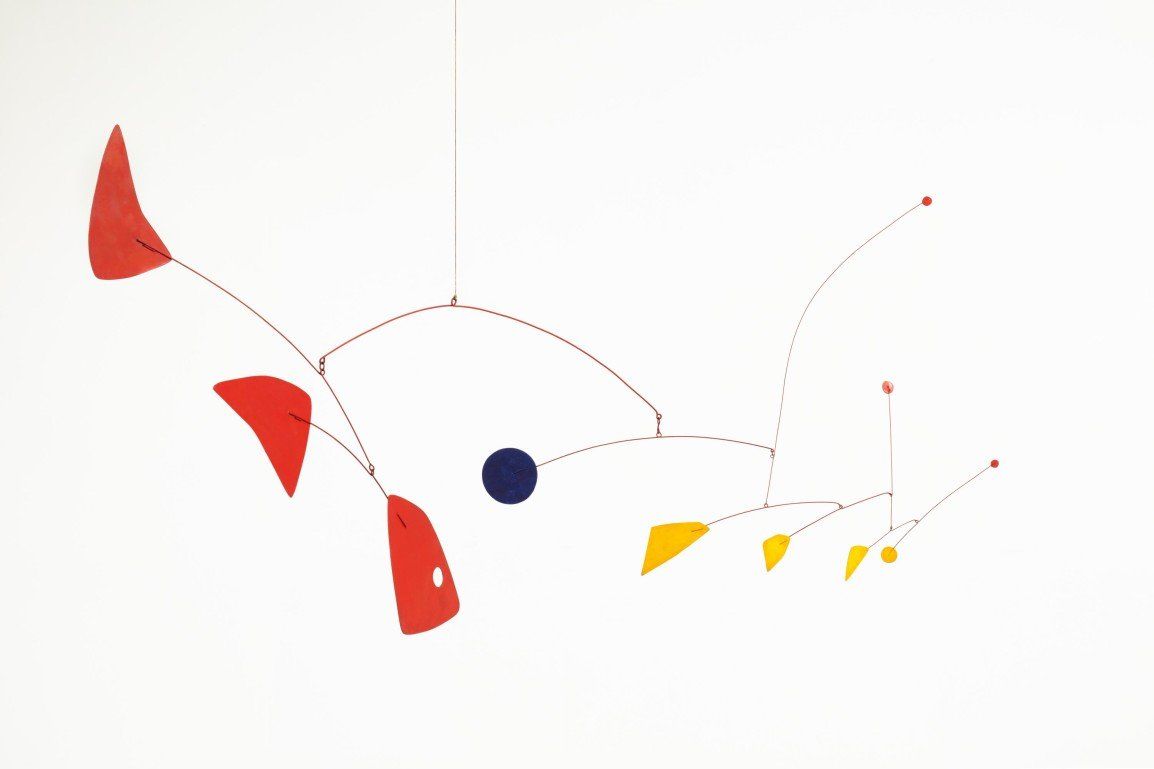
There is a running joke between some of my friends and I that ‘you’re not a museum unless you have an Alexander Calder piece in your collection on display.’ Now, of course this is a sarcastic joke, but there is some validity to it. Calder was an American sculpture best known for his innovative “mobile” sculptures who gained prominence in the art world in the 1920s. He created over 16,000 pieces of art throughout his life and they are in many of the world’s largest museums including The Guggenheim Museum, The Whitney Museum, Museum of Modern Art (MoMA), the National Portrait Gallery, and the National Gallery of Art. Personally, it seems as though every large museum I visit I see a Calder piece or two. Each time I see his work I chuckle to myself for a second and think “ahh, so here is their Calder piece.” Most recently, I saw his work during my visits to the Museum of Contemporary Art Chicago, the Virginia Museum of Fine Arts, the New Orleans Museum of Art, and the Baltimore Museum of Art. I started asking myself, “I wonder why everyone has Calder pieces??” I mean, I knew a little bit about Calder, but clearly not enough. I thought, “if he is in damn near every museum I visit, I should probably know more about him.” [ Read more ]